Rome Through the Ages:
Walking 2,700 Years of History
Most guides tell you what to see. This one tells you when it was built—and why that matters.
Most guides tell you what to see. This one tells you when it was built—and why that matters.
Most Rome guides organize sites by neighborhood or popularity. You'll visit the Colosseum (72 AD), then the Pantheon (125 AD), then maybe the Trevi Fountain (1762). Each is magnificent, but you miss the story of how Rome grew from a collection of hilltop settlements into an empire.
This guide follows a different path. We're walking through Rome chronologically—from a 2,600-year-old drainage system to defensive walls built as the empire faced new challenges. Eighteen sites spanning 600 BC to 270 AD, arranged in the order they were built.
Why chronology matters: When you visit the Servian Wall (378 BC) before the Aurelian Walls (270 AD), you see how Rome's relationship with the outside world changed over six centuries. When you walk the Circus Maximus (600 BC) and then learn about the later Colosseum, you understand that Romans refined their approach to public gathering spaces for over a thousand years.
Seeing how things developed over time reveals the connections between them.
Seven of these sites are free to visit. Eleven require admission but allow photography. The route follows a logical geographic path through the city, so you're building on what you've seen rather than crisscrossing between distant neighborhoods.
Let's begin where Rome began.
The route moves generally north to south through Rome, but more importantly, it moves forward through time. You'll start in the Regal Period when Rome was ruled by kings, continue through the Republic when the Senate held power, and end in the late Empire when Rome faced internal and external pressures.
You can walk this route in one full day, or split it across two days. The chronological sequence helps each site build on the previous one, creating a clearer picture of how Roman society evolved.
In 390 BC, Gallic warriors sacked Rome. The city burned. When Romans rebuilt, they built differently: with walls.
The Servian Wall stretched six miles around the seven hills. For 600 years, it marked where "Rome" ended and everything else began. These stones formed the sacred boundary, the pomerium. When generals returned from campaign, this is where they laid down their military command before entering the city as citizens again.
Today, sections appear throughout the city—near Termini Station, in courtyards, built into later structures. The massive tufa blocks have weathered 2,400 years, still marking that ancient division between inside and outside.
Before Rome had temples, forums, or marble columns, it solved a practical problem: drainage.
The Cloaca Maxima—"Greatest Drain"—began as an open channel to drain the marshy valley between Rome's hills. Once drained, that valley became the Roman Forum. The Forum became the heart of Roman civic life.
This isn't the dramatic history of battles and emperors, but it's foundational. Rome's expansion was built on understanding that cities need working infrastructure—sewage systems, clean water, reliable roads. Military strength mattered, but so did the ability to sustain a large urban population.
The Cloaca still functions after 2,600 years. It still drains into the Tiber, connecting ancient Rome to the modern city.
For over a thousand years, this valley held 250,000 spectators watching chariot races. Teams had devoted followings—the Blues, the Greens, the Reds, the Whites. Fans celebrated victories and rioted over defeats. Fortunes changed hands on race outcomes.
The Circus Maximus was Rome's oldest and largest venue for public entertainment. Emperors sponsored races to maintain public goodwill. Political allegiances formed around racing factions. Successful charioteers became wealthy celebrities.
Today, grass covers where the track ran. The stands have disappeared. But walking the length of the valley gives you the scale—this was a gathering space larger than most ancient cities' entire populations.
We jump forward 500 years now. The Republic has fallen. Decades of civil war have exhausted Italy. Octavian, soon to take the name Augustus, has consolidated power.
Augustus reportedly said he "found Rome a city of brick and left it a city of marble." While this overstates the transformation, he did reshape the city's public spaces. More significantly, he reshaped its message: order has replaced chaos; peace has returned.
The monuments from this period served political purposes. They celebrated the new regime while honoring tradition.
The Senate commissioned this altar to celebrate Augustus bringing peace to the Mediterranean. After generations of civil conflict, the central message was restoration: stability has returned.
The marble reliefs show the imperial family in procession—Augustus, his wife Livia, his stepsons, his adopted sons. Divine figures bless the scene. Decorative panels overflow with fruit, flowers, and symbols of agricultural abundance.
This altar communicates multiple ideas in stone: Augustus has divine favor, his family provides continuity, and Rome prospers under this leadership. It's political messaging rendered in beautiful marble relief work.
The Julio-Claudian dynasty that Augustus founded ruled for seven decades after his death, giving some substance to the altar's promises of stability.
Augustus built this tomb when he was 35 years old. Not "planned for it eventually"—built it. In the middle of Rome. Right next to where he was constructing his other monuments.
The message was unmistakable: I'm founding a dynasty. This is where my family will rest for generations.
And for a while, that's exactly what happened. Augustus, his wife Livia, his nephews, his adopted sons, the emperors Tiberius and Claudius—all buried here. Four generations of the Julio-Claudian dynasty, all resting in this massive circular tomb that dominated the Roman skyline.
Then the dynasty collapsed, and later emperors built their own tombs. But for a century, this was the symbolic center of imperial power.
Augustus built this theatre and named it after his nephew Marcellus, who died at age 19 before ever seeing it completed.
Marcellus had been positioned as Augustus' heir. His early death forced Augustus to reconsider succession plans, eventually settling on his stepson Tiberius.
The theatre seated about 15,000 people. Its design—multiple tiers, arched openings, layered column styles—established patterns that later appeared in the Colosseum. The structure demonstrates how Roman architects refined their approach to large public venues.
Today, Renaissance-era apartments occupy the upper levels of the ancient structure, showing how Romans have continuously adapted and built upon earlier foundations.
A 120-foot marble pyramid stands in Rome, near a major intersection. It's unexpected, but it fits a specific historical moment.
Gaius Cestius Epulo was a magistrate who died around 12 BC. Egypt had recently become a Roman province, and Egyptian aesthetics had become fashionable among Roman elites. Cestius chose a pyramid design for his tomb, reflecting this cultural trend.
Roman pyramids have steeper angles than those at Giza—they were modeled on Nubian pyramids instead. This one was completed in 330 days. We know the timeline because Cestius' will required it, tying his heirs' inheritance to meeting the deadline.
The tomb reflects both personal ambition and the cultural cross-pollination that came with Rome's expanding territories.
Marcus Agrippa was Augustus' closest ally, military commander, and an influential urban planner. His projects shaped how Romans thought about public space.
These were Rome's first public baths. Previously, bathing facilities were private, available only to those who could afford them. Agrippa's baths made bathing accessible to ordinary citizens. The idea that cities should provide such amenities became part of Roman urban planning.
Little remains visible today—some walls, foundations, fragments incorporated into later structures. But the concept spread. Within a century, public baths had become standard features in cities across the empire.
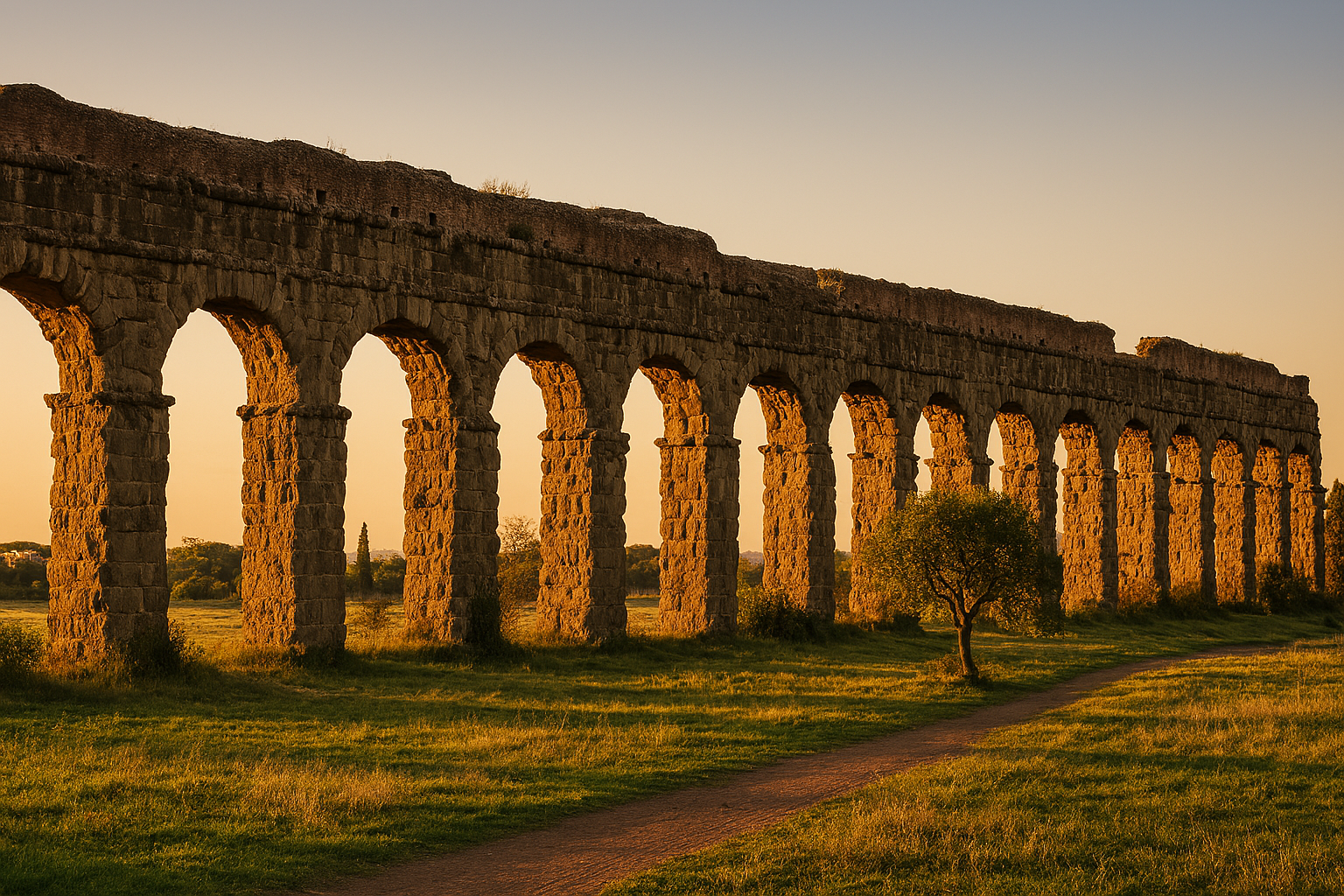
Emperor Claudius completed this aqueduct, begun under Caligula. It brought water from springs 45 miles away, with arches reaching 90 feet high at their tallest points.
Walking through Parco degli Acquedotti, you see the massive stone arches stretching across the landscape, still standing after 2,000 years. The scale is remarkable—these structures delivered water reliably across dozens of miles using only gravity and careful engineering.
The Aqua Claudia could deliver 200,000 cubic meters of water daily. This capacity supported Rome's large population—drinking water, public baths, fountains, and other urban needs. The infrastructure allowed the city to sustain population densities that required sophisticated water management.
The Forum was Rome's civic center for nearly a thousand years. Consuls took office here. Triumphal processions ended at its temples. Markets operated in its spaces. Political discussions—formal and informal—filled its basilicas and open areas.
The site is extensive. We'll focus on key structures that illustrate its role in Roman life.
The Roman Forum may be the single most historically significant site in the city. Not for its preservation—much has been lost—but for its centrality to Roman civic life across centuries.
Julius Caesar's funeral pyre burned here. Cicero delivered speeches here. Legal trials, religious ceremonies, political debates, and public celebrations all took place in this space. It was simultaneously Rome's main plaza, temple complex, and political center.
The ruins span centuries: the Temple of Saturn (497 BC, rebuilt multiple times), the Arch of Septimius Severus (203 AD), the Basilica of Maxentius (312 AD). Walking the Via Sacra—the Sacred Way—takes you through nine hundred years of Roman architectural development.
The Senate met in this building. During the Republic, it served as the main assembly space where senators debated legislation, foreign policy, and matters of war and peace. The building's role changed under imperial rule, but it retained symbolic importance.
Julius Caesar initiated construction. Augustus completed it after Caesar's assassination. The building survived because it was converted to a church in the 7th century, which preserved its structure.
Inside, the original floor remains visible. The space is modest—accommodating about 300 senators. This is where debates occurred about wars with Carthage, citizenship for Italian allies, and the limits of executive power during Caesar's time.
Many decisions that influenced subsequent Western political development were discussed in this space. The physical continuity between ancient and present makes that connection tangible.
Legend places Rome's founding here in 753 BC, when Romulus established the first settlement. Archaeological evidence confirms the hill was inhabited at least that early, possibly earlier.
During the Republic, wealthy families built homes here. Under the Empire, it became the location of imperial residences. The English word "palace" derives from "Palatine"—reflecting how completely the hill became associated with imperial power.
Remains of several imperial residences survive: Augustus' house (relatively modest in scale), Tiberius' palace, and Domitian's palace complex. The gardens offer views over the Forum and Circus Maximus. The site's long continuity—2,800 years of continuous significance—becomes apparent as you walk through the different building phases.
Take time here to absorb the layered history.
By the late 1st century AD, Rome had reached its greatest territorial extent, stretching from Britain to Mesopotamia. The city held approximately one million inhabitants. Emperors invested heavily in public building projects, each seeking to leave their mark on the urban landscape.
This was Rome's largest gladiator training facility, located adjacent to the Colosseum. An underground tunnel connected the two buildings, allowing gladiators to move directly between training and performance spaces.
The visible ruins include a training arena, living quarters, and support facilities. Successful gladiators could achieve celebrity status and earn significant money, though the profession remained dangerous. The complex housed and trained thousands of fighters.
Emperor Domitian built the Ludus Magnus as part of a broader investment in public entertainment venues. Providing free or subsidized entertainment to Rome's population was an established aspect of maintaining public order and imperial legitimacy.
Limited remains survive—mainly the circular brick foundation of what was once a monumental fountain.
The Meta Sudans was a conical fountain that stood between the Colosseum and the Arch of Constantine, marking the boundary where several administrative regions met. Historical sources describe it as a place where gladiators would pause after contests.
The visible remains were demolished in 1936 during urban modifications. Subsequent archaeological work has revealed the foundations. The site illustrates how Rome's ancient fabric has been continuously modified, sometimes through deliberate removal rather than natural decay.
The Gemonian Stairs served a grim function in Roman justice. After execution, the bodies of condemned criminals were displayed here before being discarded in the Tiber.
Historical accounts describe how Sejanus, the praetorian prefect who fell from power under Tiberius, was executed and his body exposed here, along with his family members. Sources describe public reactions ranging from vengeance to fear. The display served as a warning about the consequences of challenging imperial authority.
Little remains of the actual stairs—mostly just the slope between the Capitoline and the Forum. But Roman writers referenced them frequently, indicating their role in the city's collective consciousness. Public humiliation was one tool the state used to reinforce power.
Not all historical sites commemorate triumphs. Some record the mechanisms of control that underpinned Roman society.
Emperor Caracalla's reign (211-217 AD) was marked by internal conflict—he had his brother and co-emperor Geta murdered. Yet he also commissioned major public works, including these monumental baths.
The baths accommodated 1,600 bathers simultaneously. The complex included hot rooms (caldarium), warm rooms (tepidarium), cold rooms (frigidarium), swimming pools, libraries, gardens, and exercise spaces. Romans used bath complexes as social centers—places to exercise, read, conduct business, and socialize as well as bathe.
The scale remains impressive. Walls tower overhead. Mosaic and marble fragments suggest the original decoration. The engineering systems—underfloor heating, water supply from aqueducts, drainage—demonstrate sophisticated technical knowledge.
Late afternoon visits offer better lighting on the ruins and typically smaller crowds.
The 3rd century AD brought new pressures: civil wars, economic instability, and increased external threats. The empire's trajectory changed—not through sudden collapse but through gradual transformation, with periods of recovery alternating with renewed crises.
The architecture from this period reflects these changing circumstances.
For six centuries after the Servian Wall, Rome had no need for new fortifications. Imperial power kept threats distant. The city grew well beyond its old defensive perimeter.
By 270 AD, circumstances had changed. External pressures increased along multiple frontiers. Emperor Aurelian decided Rome needed protection again.
The construction took five years—12 miles of walls, 20 feet high, with 380 towers. They enclosed the expanded city, including all seven hills. When the Visigoths entered Rome in 410 AD, historical accounts suggest they did so through opened gates rather than by breaching the walls themselves.
Sections survive today, incorporated into churches, museums, and residential buildings. You can walk along portions. The construction differs from the Servian Wall—larger blocks, different techniques—reflecting both changed building methods and the urgency of the project.
These walls represent a shift in Rome's strategic position. The city that had long expanded outward now took defensive measures. The empire continued for two more centuries, but its relationship with the territories beyond Italy had fundamentally changed.
This gate breaks our chronological pattern—it dates to the Renaissance, not antiquity. But it's built into the Aurelian Walls and represents Rome's continuity across eras.
Pope Pius IV commissioned Michelangelo to design this gate in 1561, one of the artist's final architectural works. The design is characteristically dramatic, with elaborate decorative elements typical of Michelangelo's later style.
The gate gained additional historical significance in 1870, when Italian troops breached it during the capture of Rome, ending papal temporal control over the city. Rome became the capital of newly unified Italy, marking a major political transition.
Today it functions as an ordinary gate with traffic passing through. But it physically connects ancient Rome (the Aurelian Walls), Renaissance Rome (Michelangelo's design), and modern Rome (the site of unification). Multiple historical layers exist in one structure.
Visiting all 18 sites in one day is ambitious. Consider selecting 8-10 based on your interests:
Republican focus: Servian Wall → Circus Maximus → Roman Forum → Curia Julia → Palatine Hill
Imperial monuments: Ara Pacis → Mausoleum of Augustus → Theatre of Marcellus → Palatine Hill
Free sites only: Servian Wall → Cloaca Maxima → Circus Maximus → Aqua Claudia → Ludus Magnus → Aurelian Walls
The value lies in following the sequence. When you see how Roman engineering developed from the Cloaca Maxima (600 BC) to the Aqua Claudia (52 AD), the progression of technical knowledge becomes clear. This infrastructure allowed Rome to support a population density that most ancient cities couldn't match.
Many cities have ancient structures. Rome's particular characteristic is that multiple eras remain visible simultaneously. You can trace development from early settlements through republican expansion to imperial consolidation to late defensive measures—all within a walkable area.
Infrastructure from 600 BC still functions. Imperial monuments from the Augustan period still stand. Defensive walls from 270 AD still mark boundaries. Rather than burying each era, Romans built on existing foundations, creating layers of history that remain accessible.
This guide organizes those layers chronologically, making the connections between eras more apparent as you move through the city.
Want to explore all 163 Rome attractions in our database?
Filter by era, cost, and type. See exactly when each site was built and why it mattered.